Thursday, October 20, 2011

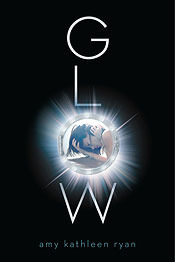
Glow by Amy Kathleen Ryan

What if you were bound for a new world, about to pledge your life to someone you'd been promised to since birth, and one unexpected violent attack made survival—not love—the issue? Out in the murky nebula lurks an unseen enemy: the New Horizon. On its way to populate a distant planet in the wake of Earth's collapse, the ship's crew has been unable to conceive a generation to continue its mission. They need young girls desperately, or their zealous leader's efforts will fail. Onboard their sister ship, the Empyrean, the unsuspecting families don't know an attack is being mounted that could claim the most important among them...
Fifteen-year-old Waverly is part of the first generation to be successfully conceived in deep space; she was born on the Empyrean, and the large farming vessel is all she knows. Her concerns are those of any teenager—until Kieran Alden proposes to her. The handsome captain-to-be has everything Waverly could ever want in a husband, and with the pressure to start having children, everyone is sure he's the best choice. Except for Waverly, who wants more from life than marriage—and is secretly intrigued by the shy, darkly brilliant Seth.
But when the Empyrean faces sudden attack by their assumed allies, they quickly find out that the enemies aren't all from the outside.

I was looking forward to this book because there aren’t that many YA stories set in a spaceship, and the possibilities are endless. Plus, the fertility issues hinted in the summary above sounded intriguing. So I happily settled into the story.

The first third is fantastic. I liked the characters, the conflict was intense, and the pacing was spot on. In fact, it only took an hour to get a third of the way through the book because I could not put it down.

Then, things took a bit of a turn, leaving me scratching my head in many places. A few characters seem to transform inexplicably, from normal to something near insane, and their motivations aren’t clear. There were a few instances where information was withheld (such as the situation surrounding Waverly’s dad and Seth’s mom), probably to heighten tension and pique the reader’s interest. But all it really did was make these characters less understandable and unsympathetic. I needed to know what was driving the characters, but that was never made clear. As a result, their actions felt contrived. By the end of the story, I didn’t like any of them anymore.

I also had issues with some aspects of the plot. Much of it didn’t make sense. For example, if a scientist is smart enough to figure out how manipulate the number of eggs released from an ovary, he’s smart enough to recognize the potential for inbred genetic issues down the road. Unless they monitor future generations with an insane zeal, they're going to have an extremely difficult time keeping half-brothers and sisters from inter-marrying.

Also, many of the characters are middle-aged with atrophied muscles. They break out in a sweat by simply carrying a dinner tray, or even walking down a hallway. Because of this, there is no way they’d be able to fire a gun with any kind of control. It takes a lot of strength to keep the kickback from knocking you on your butt, especially with the higher caliber weapons. But they fire several rounds, with no repercussions. This pulled me out of the story on several occasions because the scenes felt contrived.

The last thing I want to look at is how incredibly dark this book is. I actually like dark books a lot. I love a book that can really ‘go there’ and get to the heart of difficult and uncomfortable concepts and issues. There are plenty of difficult and uncomfortable concepts in this book, but they are a bit confusing. I think the author was trying to show both sides of the coin regarding religion, but the end result wasn’t as clear as it could have been. This is partly due to the lack of connection to the characters. If we don’t understand what is driving them, then we can’t understand where they are taking us.

The conversation between Seth and Waverly at the end really illustrates this. Waverly’s actions are somewhat understandable, considering what she’s been through. But Seth’s aren’t. In fact, it shows just how little he’s learned, and how manipulative and ruthless (borderline sociopathic) he is. And I still don’t understand why he is this way. I don't really want to spend any more time with these characters because their actions don't provoke any sympathy from me. Perhaps the next book will be better.

Monday, October 17, 2011

When Is ‘Good Enough’ Really Good Enough?

When do you consider your work good enough? When your critique partners have no more major comments? When it’s published? When it gets a starred review? When it wins an award?
Perhaps. But, for every answer, there’s a way to refute it.

 
‘It’s good enough for my critique partners, so it’s got to be good enough for an agent or editor.’
Maybe. It depends on how thorough your critique partners were, and how well you absorbed their feedback.

 
‘It’s good enough to get me an agent, so it must be good enough for an editor.’
Again, maybe. If your manuscript attracted an agent, then there’s at least one shining element to your story that she believes in. But that doesn’t mean she thinks it’s close to being done.

 
‘It’s good enough for my editor, so it must be good enough to greet the world.’
This depends on so many things. The editor could have been sold on that same shining element that attracted your agent, but that doesn’t mean the rest of the book has transformed into one big, shining story. It might have, or the editor might have gotten it to the point where the flaws were merely acceptable. Meaning, many readers may not notice or care about them, but the astute reader will likely catch them every time.

 
So, what about ‘My book got a starred review’ or ‘My book won an award’?
A starred review comes from an individual, so it means the flaws were overshadowed by the good parts for that one person. If another person from the same organization had reviewed your book, you might have gotten a different response. It all depends on taste. An award is bestowed by a group of people, and they agree that your work is deserving of this award. It’s still a small group, though. Much smaller than the rest of the reading population. So is this a good measure?

 
What does it really mean to say ‘my work is good enough’?

 
Let’s say you give your work to an agent or editor hoping she won’t notice a weak area in the story, or you assume that weak area is fine if she doesn’t say anything about it. Or, let’s say you rationalize away a voiced concern because so-and-so-author gets away with it in her books. Well, you can almost count on this coming back to haunt you, especially if you’re a debut author.

 
Once your work is out there, there’s no taking it back. If you (or someone else) notice a flaw in your work, other people will, too. Hoping, insisting, or rationalizing that something isn’t a problem doesn’t make it true. Instead, it sets you up for the firing squad that’s taken up residence on Amazon’s review forums. :)

 
For me, this is what it really means to say one’s work is good enough:
  1. You have listened with an objective ear to the feedback from your critique partners, agent, and/or editor.
  2. You have taken a good, hard look at the areas of concern (and put other successful books out of your mind).
  3. You’ve done everything you can to resolve those issues, likely moving out of your comfort zone in order to do it.
There might still be a reader who catches something that no one else did. But, you know what? That’s okay, because, if you’ve done everything above, that thing will be so minor it really won’t matter.

Thursday, October 13, 2011

Galaxy Games: The Challengers by Greg Fishbone

Things are looking up for Tyler Sato (literally!) as he and his friends scan the night sky for a star named for him by his Tokyo cousins in honor of his eleventh birthday. Ordinary stars tend to stay in one place, but Ty’s seems to be streaking directly toward Earth at an alarming rate. Soon the whole world is talking about TY SATO, the doomsday asteroid, and life is turned upside down for Ty Sato, the boy, who would rather be playing hoops in his best friend’s driveway.
Meanwhile, aboard a silver spaceship heading for Earth, M’Frozza, a girl with three eyes and five nose holes, is on a secret mission. M’Frozza is the captain of planet Mrendaria’s Galaxy Games team, and she is desperate to save her world from a dishonorable performance in the biggest sporting event in the universe.
What will happen when Ty meets M’Frozza? Get ready for the most important event in human history—it’ll be off the backboard, around the rim, and out of this world!
 
Greg Fishbone is doing a pretty cool blog tour for his book, Galaxy Games. It started on October 1st and goes through the end of the month. With each stop at a blog, he gives a clue to the Galaxy Games Puzzle Contest. I'll be hosting his tour on the 31st--the last day of the tour, and the biggest clue of them all! So be sure to stop by.
 
For participating in the tour, I received a review copy in the mail, which my eight year old son promptly claimed it so he could read it. I managed to get my hands on it while he was at school, and I can safely say that this is a book that boys will love. It's campy, silly, fun, and I laughed out loud more than once. Though the summary focuses on Ty and M'Frozza, there are other main characters that play key roles. I thoroughly enjoyed this book, and so did my son. It's along the lines of Whales on Stilts by MT Anderson, but not quite as 'out there.' Definitely fun for the whole family.
 
I'm giving away my review copy (much to my son's chagrin...I promised him I'd get him his own copy), so if you'd like to enter, then fill out the form below. I'll announce the winner on October 31st, after the final clue is revealed in the blog tour.
 

Monday, October 10, 2011

How To Get The Most Out Of A Critique, Part Five

Last week, I talked about how to incorporate feedback from an agent or editor, and today I want to talk about the fine line between holding on too tightly and knowing the feedback isn’t right for your story.
Kill your darlings. People say that over and over again, but one could argue that all of your writing consists of darlings. So, how do you know whether a darling needs to go or stay? That’s a tough call. But there are ways to figure it out.

The first step is to figure out what kind of person you are. Are you resistant to change? Are you easily influenced? Are you easily overwhelmed? Knowing this will help you tremendously because it will affect your strategy.

Resistant To Change
If this is you, then the revision process can be a complete nightmare for your critique partners. Why? If you constantly resist input, they’re going to wonder why the heck you bothered to ask them to critique your work. One who is resistant to change can easily make himself believe that he’s holding on to the key elements of his story, when they may not actually be key elements. But how do you figure out the difference?

One way is to make a list of every single issue raised in your feedback, even the ones you don’t agree with. Then, take each issue one at a time and experiment with it. What happens to the story if you make this change? Is it better or worse? Or, what happens if you add a few tweaks to this change? Then what? I’ve discovered more revision gems this way than I can count. But if you don’t try, you’ll never know. So, give it a try, and you might surprise yourself.

Easily Influenced
If this is you, then I think you have the hardest time with revision than anyone else, because it’s easy to see the merit in other people’s comments. That leads to incorporating those ideas and suggestions in your story, even if they don’t fit. Then you end up with Frankenstein’s monster, and, eventually, the whole project will likely be abandoned. How do you keep this from happening?

Again, make a list of all the comments. Instead of experimenting with them with actual writing, just think about each issue one at a time, taking it through your story from start to finish. Does it affect the setting? Does it affect how the character views certain things? Are these better or worse for your story? It’s very important that you do not start revising right away. Instead, let your mind play with these ideas and see where they fall.

Easily Overwhelmed
I think most people fall into this category, especially when you’ve got a group of people giving you feedback. Or, if you get some suggestions from an agent or editor, you can easily feel overwhelmed because of the potential for a connection. But there are ways to deal with it.

Make a list of everything, but not in the traditional way. You want to deal with each issue individually, so make your list such that you can only see one thing at a time. You could use index cards, for example, or use another sheet of paper to cover the rest of the list so you can only see one new thing at a time. Then, deal with only that issue. When you know for sure whether you should keep or discard it, move on to the next. Keep doing this until you reach the end, and don’t worry about how long it takes to get there.

There is another thing you should do regardless of what kind of person you are, and that is…

SLEEP ON IT

After you’ve made your list, set it aside and get a good night’s sleep. Or a week. Or a even a month. When you’re not actively thinking about the list, that’s when you should return to it because that’s when your brain will be the most objective. You’ll be able to see things that you probably wouldn’t have when it was all fresh. And, any emotion associated with the feedback will have had a chance to settle, and you can better assess what’s right for your story.

Really, though, it all comes down to you as an individual. The only way you’re going to figure out the best way to deal with feedback is to experiment with various systems and see what feels right. If you haven’t done this yet, get to it. :)

Thursday, October 06, 2011

Blood Red Road by Moira Young

Saba has spent her whole life in Silverlake, a dried-up wasteland ravaged by constant sandstorms. The Wrecker civilization has long been destroyed, leaving only landfills for Saba and her family to scavenge from. That's fine by her, as long as her beloved twin brother Lugh is around. But when a monster sandstorm arrives, along with four cloaked horsemen, Saba's world is shattered. Lugh is captured, and Saba embarks on an epic quest to get him back. Suddenly thrown into the lawless, ugly reality of the world outside of desolate Silverlake, Saba is lost without Lugh to guide her. So perhaps the most surprising thing of all is what Saba learns about herself: she's a fierce fighter, an unbeatable survivor, and a cunning opponent. And she has the power to take down a corrupt society from the inside. Teamed up with a handsome daredevil named Jack and a gang of girl revolutionaries called the Free Hawks, Saba stages a showdown that will change the course of her own civilization.

The tension in this story is non-stop from beginning to end, and the pacing leaves you breathless. I finished this book in a day and a half simply because I couldn't put it down.

That said, the beginning was a little hard to get through. Saba did not come across as likable or interesting. Her sun rises and sets with her brother (which, at 18 years old, kinda creeps me out), she's horrible to her little sister, and she has absolutely no curiosity. She’s even less likable after Lugh is taken and her obsession with him is moved front and center.

When Saba lands in the cage so easily, I considered setting this book down. The plot at this point rubbed me the wrong way because it felt clunky, though I can't quite put my finger on why. However, I'm glad I kept reading because Saba becomes so much better by the end. Her transformation is gradual and believable, and everything she went through directly affects her growth. It makes sense why she had to endure the things she endured, because it enables her growth toward the end. I’m very glad I stuck with this book.

There was one thing, however, that I could not get over... I really really didn't like the writing style. The lack of quotes and the misspellings in order to get the voice to come through made the prose too difficult to read. I had to stop too many times to ponder out several words, as well as what was being said aloud. I prefer to be seamlessly submerged in a story, and this writing style doesn't allow that.

I am still interested in reading more, though I do hope it's easier to read. And I hope the next story follows Jack. I didn't feel like I knew him very well by the end, and I still think he's got secrets. I'd like to know what they are.

Monday, October 03, 2011

How To Get The Most Out Of A Critique, Part Four

Last week, I talked about how to incorporate a critiquer’s feedback into your work. Today, I want address what happens if that feedback comes from an agent or editor.
It’s one thing to dismiss feedback from another writer, but it gets more complicated when it comes from an agent or editor. After all, they’re the ones who can get us to that coveted that Published and Listed status. All of a sudden, the stakes have gone up.

When an agent requests your full manuscript, what’s the first thing you do? You cheer, of course! A request is a good thing, which could lead to other good things. And if that agent likes your story but has a few misgivings, she might offer you some advice to revise. If she really likes it, she might even invite you to resubmit. This is great cause for celebration, closely followed by nauseating nerves. This could be your chance to snag an agent, so you want to do your absolute best work. Plus, agents have their fingers on the pulse of the industry so if you do what she tells you to do, it’ll be all right. Right?

Wrong.

It’s easy to get caught up in revising for an agent or editor because they are directly responsible for getting you published. The problem is that you can lose sight of your story and focus on doing what she says, which may or may not work. If it doesn’t work, then the agent/editor is going to say no, and you might be upset and frustrated because you did all that work for nothing.

It’s possible that, after all that work, your story really is stronger and the agent just didn’t love it enough to take it on. Or, it’s possible that you did all that work for nothing. How do you know which is true?

An agent just a person and not much different from a fellow critquer, except that she has more insight and experience with respect to the industry. But she doesn’t have more insight into your story than your critique partner does. She can’t, because she’s not you. No one has better insight than you do.

I’ve heard many writers lament about doing revisions for an agent only to be turned down. This sometimes turns into a complaint about how the agent demanded they write the story for her instead of letting them stay true to the story. The writers almost always swing to the other extreme and they proclaim that they are through with writing for other people and will only write for themselves—often coupled with an aversion to feedback.

These writers don’t know it, but they fell victim to the idea that if they do what an agent tells them to do, it’ll get them published. Which they’ve just proven isn’t always true. So, what do you do about that?

You write for you, of course. :) To do that, you use the same methods to incorporate feedback that you used with your critique partner.

The difference is that you have more to lose, i.e. the agent or editor could pass on your story. This sucks, but that’s how it is. Blindly following an agent’s advice won’t necessarily get you anywhere, either. Therefore, it’s even more important that you assess an agent’s feedback with a critical eye, because she’s likely revealing flaws in your story that you need to address. BUT, that doesn’t mean you need to fix the problem in the exact way she suggests. She doesn’t know the story the way you do, and could unknowingly be introducing other problems. In fact, if you don’t take her advice and fix the problem in a different way, she’ll be impressed. It shows that you have a good head for revision, and she’ll be more inclined to want to work with you.

It’s complicated, but there’s not really a way around that. All we can do is write the best story we can, then stay true to it as we strive to make it better. A good agent or editor will recognize and appreciate that.